

Sustainability · 2025
In this section48 topics
- Sustainability Policy1 item
- Sustainability Goals & UN SDGs1 item
- Policy Review2 items
- Business Value Chain1 item
- Stakeholder Analysis1 item
- Environmental Sustainability — Overview1 item
- Environmental Policy & Guidelines3 items
- Environmental Policy Review1 item
- Energy — Plan & Guidelines2 items
- Energy — Electricity Consumption1 item
- Energy — Fuel Consumption2 items
- Energy — Targets1 item
- Energy — Performance & Outcomes1 item
- Water — Plan & Guidelines2 items
- Water — Withdrawal, Discharge & Consumption1 item
- Water — Targets2 items
- Water — Performance & Outcomes1 item
- Waste — Plan & Guidelines2 items
- Waste — Generation, Disposal & Recycling1 item
- Waste — Targets2 items
- Waste — Performance & Outcomes1 item
- GHG — Plan & Guidelines2 items
- GHG — Emissions1 item
- GHG — Emissions Verification3 items
- GHG — Targets1 item
- GHG Targets — Other Targets1 item
- GHG — Performance & Outcomes2 items
- Environmental Legal Incidents1 item
- Social Policy & Guidelines3 items
- Social Policy Review3 items
- Human Rights Due Diligence3 items
- Employees — Plan & Guidelines3 items
- Employees — Workforce1 item
- Employees — Remuneration & Provident Fund1 item
- Employees — Training & Development1 item
- Employees — Occupational Health & Safety1 item
- Employees — Labour Relations1 item
- Employees — Employee Representation2 items
- Employees — Targets3 items
- Employees — Performance & Outcomes2 items
- Customers — Plan & Guidelines3 items
- Customers — Satisfaction Results2 items
- Customers — Targets2 items
- Customers — Performance & Outcomes2 items
- Community & Social — Plan & Guidelines3 items
- Community & Social — Targets1 item
- Community & Social — Performance & Outcomes2 items
- Law Violation Incidents1 item
Sustainability Policy
Has a Sustainability Policy
No
Sustainability Goals & UN SDGs
Has Sustainability Goals
No
Policy Review
Policy Reviewed This Year
No
Policy Changed This Year
No
Business Value Chain
Value Chain Description
Business drive for sustainability
Managing the impacts on stakeholders in the business value chain
Business value chain
The Company has business chain management with awareness of sustainable value creation for all stakeholders which involves conducting business from upstream to downstream by identifying it as a business value chain.
The main activities
consist of 5 activities according to the overall business operations as follows:
1. Management of means of production Sourcing and purchasing quality raw materials, giving precedence to the use of local raw materials and procurement with fairness to contract farmers of the Company
2. Operations Give precedence to production control, raw material processing that reduce the amount of waste from the production process and will affect the environment, with safety in the production process; control the product quality to meet the standards as specified; pack products in standardized packaging to maintain the quality of the product.
3. Distribution The warehouse can store products to maintain the quality of the product well. Storage and transport of products are convenient. Transport service providers, that meet standards in transporting goods through various distribution channels covering both retail and wholesale, are selected.
4. Marketing and Sales Set the right price. Provide production information on the label with a clear expiration date and display a mark on the packaging to show the quality and standard of the product. There are various distribution channels, covering wholesale and retail including foreign sales
5. After-sales service Product warranty; supplier satisfaction assessment; service department receiving comments, suggestion and criticism about the product.
Supporting activities
For the main activities to proceed smoothly and achieve that goal, there must be effective support, operating properly on development of technology for the product, organization management, human resources management, accounting and finance system that will help the main activities run smoothly to help save costs, shorten working time with outputs being more productive.
Stakeholder Analysis
Stakeholder Analysis
| Stakeholder Type | Stakeholders | Stakeholder Expectations | Response to Expectations |
|---|---|---|---|
| Internal stakeholders | 2913 · Description: Shareholders | o Continuous growth of operating results
o Dividend payment
o Disclosure of correct and complete information
o Good corporate governance
o Good auditing and internal control systems
| o Generating good performance and paying dividends appropriately
o Transparent and timely disclosure of information
o Establish and comply with policies and business ethics.
|
| Internal stakeholders | 2921 · Description: Employees | o Appropriate compensation and welfare system
o Career advancement and stability
o Good and safe working environment
o Training to develop work knowledge
o Fair treatment without exclusion or discrimination.
| o Provide compensation appropriate to the position.
o Support potential and stability and progress in work and growth with the organization.
o Work safely, properly manage workspace according to ISO 14001 and ISO45001 systems.
o Support the development of working abilities.
|
| Internal stakeholders | 2923 · Description: Customers | o Receive quality products.
o Attentive after-sales service with warranty.
o Manage quality complaints
o Protect customer information and maintain confidentiality.
| o Develop and maintain product quality to meet customer requirements.
o Address issues quickly and efficiently
o Measures are in place to protect customer information and confidentiality.
|
| Internal stakeholders | 2899 · Description: Suppliers | o Treat business partners fairly, transparently and equally.
o Comply with agreements.
o Build long-term business relationships
| o Follow the framework of honest purchases and services
o Principles for selecting partners and clear audit processes
o Evaluate results fairly.
o Strictly comply with trade conditions.
|
| External stakeholders | 2902 · Description: Community | o Social responsibility taking into account the overall benefits.
o Promote and support development of activities beneficial to society, the environment and safety.
o Efficient use of shared resources
| o Participate in activities beneficial to the community and society.
o Promote and support what is beneficial to the environment and community safety
o Receive suggestions and complaints from the community to find solutions together.
|
| External stakeholders | 2931 · Description: Government agencies and Regulators | o Obey the law and government policy
o Cooperate in submission of information, reports and various documents to the designated government agencies completely.
| o Comply with relevant laws on environment and safety.
o Submit reports and documents to designated government agencies completely.
|
Environmental Sustainability — Overview
Operating Results — Introduction
Khonburi Sugar Public Company Limited (KBS) reports environmental operating results across four facilities: the Khon Buri sugar factory (KBS-KB), the Si Khio sugar factory (KBS-SK), Khon Buri Power Plant (KPP), and KBS Power Co., Ltd. (KBSP) at Si Khio. BE 2568 (2025) marks the first year of consolidated, externally verified environmental data for the organisation. Energy data covers biomass electricity generation (approximately 60 MW total installed capacity) and fossil fuel consumption across all sites. Greenhouse gas emissions for BE 2568 were calculated under the TGO Carbon Footprint of Organization standard (8th edition) and ISO 14064-1:2018, with external verification underway by Bureau Veritas (BE 2568 / 2025); BE 2567 base year emissions were verified by SGS. Water and waste data for BE 2568 will be reported following completion of the full annual sustainability review. KBS holds ISO 14001 environmental management system certification across its operations.
Environmental Policy & Guidelines
Has an Environmental Policy
Yes
Policy Description
Policies and guidelines on society, communities and the environment
The Company is committed to conducting business with ethics, aims to understand and communicate with society the status and facts of the Company's operations, including the Company's responsibility to the community, society and environment without concealing facts that may be disclosed. In addition, it is committed to participating in the development of the community in which the business operates and society as a whole. in terms of economy, society, community and environment.
Guidelines for conserving the environment, energy and natural resources
1. The Company must comply with laws, regulations, environmental management standards and other requirements related to the environment, energy and natural resources in the business operations of the Company.
2. The Company is committed to conducting business with regard to the environment in terms of ecosystem management and biodiversity and climate and environment
3. The Company is committed to management with the goal of preventing and controlling the impact on the environment and controlling activities that may cause a risk of wasting energy and natural resources.
4. The Company is committed to continually reviewing and developing environmental management in terms of energy saving, use of renewable energy, resource conservation, reuse of materials and proper disposal of waste or hazardous materials.
5. The Company provides continuous evaluation and monitoring of its operations or impacts on environment, energy and natural resources. 6. The Company strives to create correct knowledge and understanding for various stakeholders on preserving the environment, energy and natural resources, as well as promoting and cooperating on various public relations activities related to the organization government agencies, society and the general public.
7. The Company is committed to developing knowledge on conservation of the environment, energy and natural resources to create innovations that are beneficial to the business operations of the Company.
Environmental Guidelines
| Guideline |
|---|
| Electricity Management |
| Water Management |
| Air Quality Management |
| Noise Pollution Management |
Environmental Policy Review
Policy Reviewed This Year
No
Energy — Plan & Guidelines
Has an Energy Management Plan
Yes
Plan Description
Committed to improving the efficiency of biomass electricity generation by controlling fuel moisture content to achieve higher calorific values, improving production processes through heat loss prevention, ensuring complete combustion, and managing waste and pollution with a dust collection system under Real time real-time monitoring, to enable sustainable factory operations, reduce costs, and minimise environmental impact.
Energy — Electricity Consumption
Electricity Consumption
| Metric | Current Year | Previous Year | Two Years Ago |
|---|---|---|---|
| Total electricity consumption within the organization (Kilowatt-Hours) | 372,458,495 | 345,956,186.03 | 365,574,119 |
| Electricity purchased for consumption from non-renewable energy sources (Kilowatt-Hours) | |||
| Electricity purchased or generated for consumption from renewable energy sources (Kilowatt-Hours) |
Energy — Fuel Consumption
Fuel Consumption
| Metric | Current Year |
|---|---|
| Crude oil (Barrels) | |
| Coal (Metric tonnes) | |
| Jet fuel (Litres) | |
| Diesel (Litres) | 676,908.71 |
| Gasoline (Litres) | 11,584 |
| Fuel oil (Litres) | |
| Natural gas (Standard cubic feet) | |
| LPG (Kilograms) | 149,127 |
| Steam (Metric tonnes) |
Other Fuels
| Fuel | Unit |
|---|---|
| LPG | 1672 · Description: Kilograms |
Energy — Targets
Has Set Targets
No
Energy — Performance & Outcomes
Has Performance Results
No
Water — Plan & Guidelines
Has a Water Management Plan
Yes
Plan Description
The initiative aims to strengthen sustainable water management by emphasizing water reuse to maximize value, alongside enhancing water storage capacity during the rainy season to ensure sufficient water reserves for the dry season. This approach helps reduce the risk of water shortages across all sectors of the country.
Water — Withdrawal, Discharge & Consumption
Water Withdrawal, Discharge & Consumption
| Metric | Current Year | Previous Year | Two Years Ago |
|---|---|---|---|
| Total water withdrawal (Cubic meters) | 2,348,706 | 2,357,799 | 2,267,232.36 |
| Total water withdrawal by third-party water (Cubic meters) | |||
| Total water withdrawal by surface water (Cubic meters) | |||
| Total water withdrawal by groundwater (Cubic meters) | |||
| Total water withdrawal by seawater (Cubic meters) | |||
| Total water withdrawal by produced water (Cubic meters) | |||
| Percentage of wastewater treated before discharge (%) | |||
| Total water discharge (Cubic meters) | |||
| Total water discharge to third-party water (Cubic meters) | |||
| Total water discharge to surface water (Cubic meters) | |||
| Total water discharge to groundwater (Cubic meters) | |||
| Total water discharge to seawater (Cubic meters) | |||
| Total water consumption (Cubic meters) | 2,348,706 | 2,357,799 | 2,267,232.36 |
| Recycled water (Cubic meters) |
Water — Targets
Has Set Targets
Yes
Targets
| Target | Target Year | Target Change (%) | Unit |
|---|---|---|---|
| Increase of recycled water for consumption | 2,030 | 10 | Cubic meters |
Water — Performance & Outcomes
Has Performance Results
No
Waste — Plan & Guidelines
Has a Waste Management Plan
Yes
Plan Description
The organization implements waste segregation by categorizing waste into general waste, recyclable waste, hazardous waste, and industrial waste to support proper disposal and resource utilization in accordance with environmental principles. Residual resources, such as bagasse, are utilized as fuel for electricity generation, while ash is appropriately used as a soil improvement material for the agricultural sector.
Waste — Generation, Disposal & Recycling
Waste Generation, Disposal & Recycling
| Metric | Current Year | Previous Year | Two Years Ago |
|---|---|---|---|
| Total waste generated (Kilograms) | 377,274.4 | 494,210 | 546,060 |
| Non-hazardous waste (Kilograms) | |||
| Non-hazardous waste - Landfilling (Kilograms) | |||
| Non-hazardous waste - Incineration (with energy recovery) (Kilograms) | |||
| Non-hazardous waste - Incineration (without energy recovery) (Kilograms) | |||
| Non-hazardous waste - Other disposal operations (Kilograms) | |||
| Hazardous waste (Kilograms) | |||
| Hazardous waste - Landfilling (Kilograms) | |||
| Hazardous waste - Incineration (with energy recovery) (Kilograms) | |||
| Hazardous waste - Incineration (without energy recovery) (Kilograms) | |||
| Hazardous waste - Other disposal operations (Kilograms) | |||
| Total reused/recycled waste (Kilograms) | |||
| Reused/Recycled non-hazardous waste (Kilograms) | |||
| Reused non-hazardous waste (Kilograms) | |||
| Recycled non-hazardous waste (Kilograms) | |||
| Reused/Recycled hazardous waste (Kilograms) | |||
| Reused hazardous waste (Kilograms) | |||
| Recycled hazardous waste (Kilograms) |
Waste — Targets
Has Set Targets
Yes
Targets
| Waste Type | Disposal Approach | Target | Target Year | Target Change (%) | Unit |
|---|---|---|---|---|---|
| Non-hazardous waste | 2758 · Description: Reuse · 2760 · Description: Landfilling | Reduce waste volume | 2,030 | 10 | Kilograms |
Waste — Performance & Outcomes
Has Performance Results
No
GHG — Plan & Guidelines
Has a GHG Management Plan
Yes
Plan Description
KBS has established a greenhouse gas management plan aligned with the Carbon Footprint of Organization (CFO) standard by TGO (8th edition) and ISO 14064-1:2018. The company completed its first externally verified CFO for BE 2568 (2025), covering all four facilities: KBS-KB (Khon Buri sugar factory), KBS-SK (Si Khio sugar factory), KPP (Khon Buri power plant), and KBSP (KBS Power, Si Khio power plant). Verification was conducted by AEP Co., Ltd. with Limited Assurance. The company has registered a T-VER carbon credit reduction project at the Sikeaw factory (up to 140,000 credits/year from BE 2567) and trades Renewable Energy Certificates (I-REC/TIGR) from its biomass power plants. GHG reduction targets are now established — see Target T-7 in the Energy Management section.
GHG — Emissions
GHG Emissions
| Metric | Current Year | Previous Year | Two Years Ago |
|---|---|---|---|
| Total GHG emissions (Metric tonnes of carbon dioxide equivalent) | 55,537 | 44,106 | 0 |
| Total greenhouse gas emissions 1 (Metric tonnes of carbon dioxide equivalent) | 53,703 | 41,531 | |
| Total greenhouse gas emissions 2 (Metric tonnes of carbon dioxide equivalent) | 1,834 | 2,575 | |
| Total greenhouse gas emissions 3 (Metric tonnes of carbon dioxide equivalent) |
GHG — Emissions Verification
Emissions Verified by a Third Party
Yes
Verifying Body
2656
Verifying Body — Please Specify
Bureau Veritas
GHG — Targets
Has Set GHG Targets
Yes
GHG Targets — Other Targets
Other GHG Targets
| Emission Scope | Base Year | Base Year Emissions | Long-term Target Year | Long-term Target Value | Long-term Target Change (%) | Unit |
|---|---|---|---|---|---|---|
| 2715 | 2,024 | 0.09 | 2,030 | 0.08 | 5 | Metric tonnes of carbon dioxide equivalent |
GHG — Performance & Outcomes
Has Performance Results
Yes
Performance Description
Total GHG emissions for BE 2568 (2025): Scope 1 = 53,703 tones of carbon dioxide equivalent; Scope 2 = 1,834 tones of carbon dioxide equivalent; Scope 3 = 122,127 tones of carbon dioxide equivalent ; Total (Scope 1+2+3) = 177,664 tones of carbon dioxide equivalent. Biogenic emissions reported separately: 1,026,145 tones of carbon dioxide equivalent (primarily from combustion of bagasse 813,637 tones of carbon dioxide equivalent, fuel wood 201,449 tones of carbon dioxide equivalent, and cane leaves 10,967 tones of carbon dioxide equivalent). Scope 1 emissions increased 29% vs base year BE 2567 (41,531 tones of carbon dioxide equivalent), primarily due to higher methane emissions from wastewater treatment (32,192 tones of carbon dioxide equivalent, 60% of Scope 1). Scope 2 decreased 29% vs base year (2,575 tones of carbon dioxide equivalent) reflecting reduced grid electricity purchase. Carbon intensity (Scope 1+2) for base year BE 2567: 0.0895 tones of carbon dioxide equivalent per tone of product (492,806 tones output). BE 2568 product output not yet finalized. External verification: Limited Assurance by AEP Co., Ltd. (5% materiality threshold).
Environmental Legal Incidents
Legal Violation Incidents
| Metric | Current Year | Previous Year | Two Years Ago |
|---|---|---|---|
| Number of cases or incidents of legal violations or negative environmental impact (cases) | 0 | 0 | 0 |
Human Rights Due Diligence
Introduction
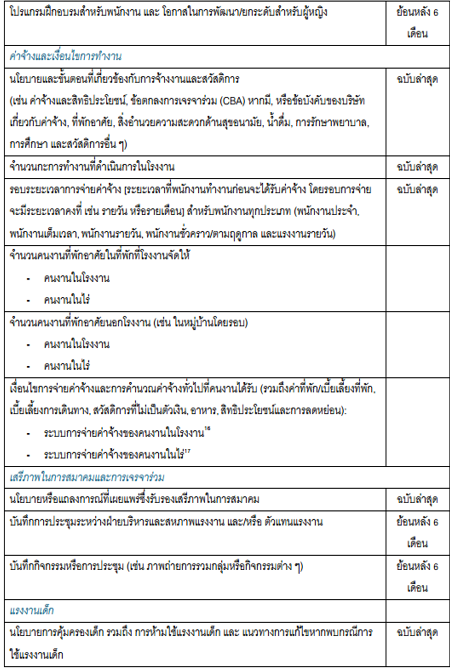
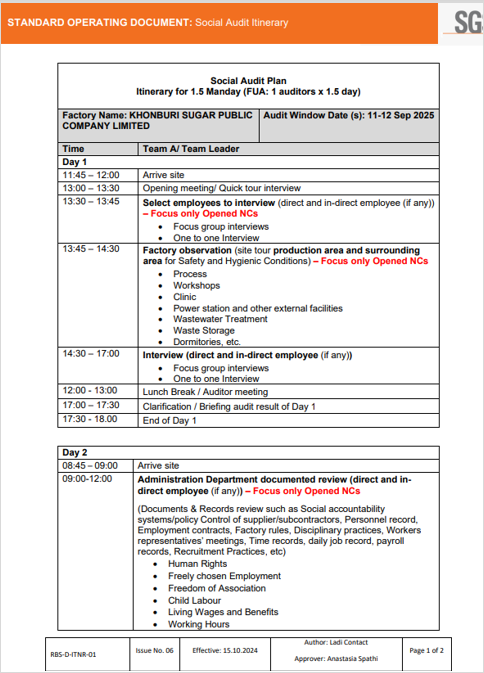
Conducts Human Rights Due Diligence
Yes
Due Diligence Description
The Company undergoes annual assessments to ensure that its operations do not cause human rights impacts or violations and that equal treatment practices are upheld. Examples of related audit plans on ethics and human rights are as follows.
Employees — Plan & Guidelines
Has an Employee Management Plan
Yes
Plan Description
Management plan
o Appropriate compensation and benefits system
o Career advancement and stability
o Good and safe working environment
o Training for work knowledge development
o Act fairly, without discrimination or selective treatment.
Response approach
o Provide compensation appropriate to the job position.
o Support potential and stable progress in work and grow with the organization.
o Work safely, manage the workspace correctly according to ISO 14001 and ISO45001.
o Support the development of work ability
Plan Areas
| Plan Area |
|---|
| Fair employee compensation |
| Employee training and development |
| Promoting employee relations and participation |
| Occupational health and safety in workplace |
Employees — Workforce
Workforce Data
| Metric | Current Year | Previous Year | Two Years Ago |
|---|---|---|---|
| Total number of employees (Persons) | 1,124 | 1,097 | 1,088 |
| Number of male employees (Persons) | 882 | 868 | 868 |
| Number of female employees (Persons) | 242 | 229 | 220 |
| Total employment of disabled persons (people) | 19 | 17 | 17 |
| Total disabled employees (people) | 19 | 17 | 17 |
| Total male disabled employees (people) | 19 | 17 | 17 |
| Total female disabled employees (people) | 0 | 0 | 0 |
| Total disabled workers who are non-employee (people) | 0 | 0 | 0 |
| Contributions to the fund for promoting and improving the quality of life for disabled persons | 0 | 0 | 0 |
| Total number of male employees in operational level (Persons) | 839 | 827 | 823 |
| Total number of male employees in management level (Persons) | 29 | 27 | 33 |
| Total number of male employees in executive level (Persons) | 14 | 14 | 12 |
| Total number of female employees in operational level (Persons) | 227 | 212 | 204 |
| Total number of female employees in management level (Persons) | 15 | 17 | 16 |
| Total number of female employees in executive level (Persons) | 0 | 0 | 0 |
Employees — Remuneration & Provident Fund
Remuneration & Provident Fund
| Metric | Current Year | Previous Year | Two Years Ago |
|---|---|---|---|
| Total disabled employees (people) | 560,730,269 | 521,586,524 | 382,293,830 |
| Total male employee remuneration (Baht) | 433,611,264 | 407,441,411 | 313,578,103 |
| Total female employee remuneration (Baht) | 127,119,005 | 114,145,113 | 68,715,727 |
| Number of employees eligible to participate in PVD (persons) | 998 | 998 | 998 |
| Total number of employees joining employee provident fund (Persons) | 826 | 722 | 671 |
| Percentage of total number of employees joining employee provident fund to total number of employees (%) | 73.49 | 65.82 | 61.67 |
| Number of PVD members / Total eligible employees (%) | 82.77 | 72.34 | 67.23 |
| Total amount of provident fund contributed by the Company (Baht) | 15,520,297 | 14,929,422 | 13,624,826 |
| Total amount of provident fund contributed by employee (baht) | 11,456,685 |
Employees — Training & Development
Training Data
| Metric | Current Year | Previous Year | Two Years Ago |
|---|---|---|---|
| Average employee training hours (Hours / Person / Year) | 22.54 | 27.56 | 20.82 |
| Employee development and training expenses (baht) | 4,273,157 | 5,969,012 | 2,198,661 |
Employees — Occupational Health & Safety
Occupational Health & Safety Data
| Metric | Current Year | Previous Year | Two Years Ago |
|---|---|---|---|
| Total number of lost time injury incidents by employees (Cases) | 7 | 14 | 4 |
Employees — Labour Relations
Labour Relations Data
| Metric | Current Year | Previous Year | Two Years Ago |
|---|---|---|---|
| Total voluntary resignations (Persons) | 59 | 95 | 98 |
| Male employees who voluntary resigned (Persons) | 42 | 71 | 69 |
| Female employees who voluntary resigned (Persons) | 17 | 24 | 29 |
| Percentage of employee turnover leaving the Company voluntarily (%) | 5.25 | 8.66 | 9.01 |
| Evaluation result of employee engagement | 0 | 0 | 0 |
Employees — Employee Representation
Employees Are Represented Collectively
Yes
Forms of Representation
| Form |
|---|
| Welfare committee |
| Employee committee |
| Labor relations committee |
Employees — Targets
Introduction
The Company recognizes and places great importance on human rights and social responsibility. It is committed to conducting its business ethically while demonstrating respect for internationally recognized human rights and human dignity. This commitment also covers fair labor practices, as employees are one of the Company’s key stakeholders. The Company strictly adheres to principles relating to labor practices, including fair treatment of workers, employment practices, wage payment, working days and hours, freedom of association and collective bargaining, as well as occupational health and safety
Has Set Employee Targets
Yes
Targets
| Indicator | Target Areas | Base Year | Target Year | Target Year — Description |
|---|---|---|---|---|
| - Recruitment channels, add at least 1 channel - Internal rotation not less than 3 positions - Internal adjustment not less than 10 positions | 2990 · Other name: Recruitment · Description: Others | 2,025 | 2,025 | -Establish a labor network for workforce sourcing
-Implement job rotation with a multifunctional approach
-Consider internal position adjustments within production / agricultural machinery lines |
| Training according to the plan not less than 85 % | 2984 · Description: Employee training and development | 2,025 | 2,025 | -Training completion rate in 2025: 96.20% of the planned training programs. |
| Zero incidents of child labor violations were reported. | 2987 · Description: Child labor | 2,025 | 2,025 | No violations or encouragement of child labor practices were identified. |
| -100% on-time wage payment. -0% wage payment error rate. | 2990 · Other name: Wage payment · Description: Others | 2,025 | 2,025 | Wages were paid on time in accordance with the payroll schedule at a 100% rate. |
| More than 80% of employees complied with the overtime policy, with voluntary consent and working hours not exceeding legal limits. | 2990 · Other name: Overtime work · Description: Others | 2,025 | 2,025 | Employees voluntarily agreed to work overtime in accordance with assigned shift schedules based on operational requirements, with no forced overtime |
| No labor complaints related to forced labor. | 2990 · Other name: Prevention of forced labor · Description: Others | 2,025 | 2,025 | No complaints related to forced labor were reported. |
| Number of complaints and suggestions submitted to the organization | 2990 · Other name: Freedom of association and collective bargaining. · Description: Others | 2,025 | 2,025 | Number of complaints and suggestions Employee feedback is provided through the Welfare Committee during scheduled meetings, with no labor-related complaints reported. |
Employees — Performance & Outcomes
Has Performance Results
Yes
Performance Description
Continuously develop and improve the efficiency of safety operations to reduce the risk of injury or death and appropriately care for the quality of life of employees. Provide a good and safe working environment based on regulations. Prepare for emergency prevention rigorously to protect workers. Environmental quality measurements are conducted annually, measuring noise levels in the workplace, personal noise exposure levels, heat values, and light intensity within the establishment. In 2024, all items passed the standard values.
Customers — Plan & Guidelines
Has a Customer Management Plan
Yes
Plan Description
Customer Management Plan
o Receive quality products
o Attentive after-sales service with product warranty
o Quality complaint management
o Protect and maintain customer confidentiality
Response approach
o Develop and maintain product quality to meet customer needs
o Fast and efficient problem solving
o Have measures to protect customer data and confidentiality
Plan Areas
| Plan Area |
|---|
| Responsible production and services for customers |
| Development of customer satisfaction and customer relationship |
| Protection of customer personal information |
Customers — Satisfaction Results
Introduction
The Company conducts a customer satisfaction survey once a year, with the passing criterion set at 90%. The evaluation covers three key aspects as follows:
Product and packaging quality
Delivery performance
Pre- and post-sales service qualit
Customer Satisfaction Results
| Metric | Current Year | Previous Year | Two Years Ago | Remark |
|---|---|---|---|---|
| Evaluation results of customer satisfaction | 1 | 1 | 1 | Customer satisfaction assessment results 2023 = Total Score 92% - Product and packaging quality = 92% - Product delivery quality = 90% - Pre- and after-sales service quality = 92% 2024 = Total Score 92% - Product and packaging quality = 93% - Product delivery quality = 92% - Pre- and after-sales service quality = 92% 2024 = Total Score 94% - Product and packaging quality = 95% - Product delivery quality = 92% - Pre- and after-sales service quality = 95% |
Customers — Targets
Has Set Customer Targets
Yes
Targets
| Indicator | Target Areas | Base Year | Base Year — Description | Target Year | Target Year — Description |
|---|---|---|---|---|---|
| Sales Volume | 3011 · Other name: Increase domestic sales volume · Description: Other | 2,019 | Domestic customer sales 53,000 tons | 2,026 | Domestic customer sales 100,000 tons |
Customers — Performance & Outcomes
Has Performance Results
Yes
Performance Description
The domestic sales volume has shown an increasing trend since 2019, driven by the expansion of the customer base in areas surrounding the factory and nearby regions. However, in 2025, domestic sales declined due to weakened consumer purchasing power, along with border issues with neighboring countries
Community & Social — Plan & Guidelines
Has a Community & Social Plan
Yes
Plan Description
Social, Community, and Environmental Activities
In 2025, Khonburi Sugar Public Company Limited and its group continued to uphold its policy of conducting business alongside community engagement and corporate social responsibility (CSR), in alignment with the Sustainable Development Goals (SDGs). The Company has driven various projects and activities based on the fundamental principle of sustainable community and social development known as “BWR” (Ban, Wat, School), which consists of Home, Temple, and School. This approach supports and aligns with the Sustainable Development Goals (SDGs) established by the United Nations.
1. “B” – Homes, Villages, and Communities
In addition to taking care of the quality of life of employees and their families, Khonburi Sugar Public Company Limited and its group also recognize the importance of supporting and caring for surrounding communities, particularly those located near the factories, in accordance with Environmental Impact Assessment (EIA) requirements. The Company has continuously implemented community projects and activities and further developed initiatives from the previous fiscal year, including the following:
The Company implemented the “KBS Care and Share” project by visiting communities together with community leaders, village headmen, and village health volunteers to visit and provide essential consumer goods to bedridden patients, persons with disabilities, and underprivileged residents living in communities surrounding the factory on a monthly basis.
The Company provided financial support and participated in monthly meetings of 12 villages surrounding the factory to promote good relationships with the community, support democratic governance under the constitutional monarchy, and facilitate public relations and information exchange in a local tripartite cooperation framework among the public sector, government agencies, local administrative organizations, and the Company as a private sector organization.
The Company provided financial support and participated in the monthly mobile meetings of village headmen in Chorakhe Hin Subdistrict, Khon Buri District, Nakhon Ratchasima Province, which helped strengthen relationships between the Company and community leaders and served as a communication channel between local authorities and the Company.
The Company supported local administrative organizations in housing construction and renovation projects for underprivileged residents living in communities surrounding the factory.
The Company supported local authorities and local administrative organizations in improving and repairing public utilities within the communities, including public road repairs, removal of water hyacinth weeds from canals and water sources, and repair of village public announcement towers.
The Company supported community enterprise projects of the Nakhon Ratchasima Provincial Industry Office under the Ministry of Industry’s MIND policy by providing raw materials such as molasses, filter cake, and bagasse ash for the production of bio-fertilizer to improve soil quality sustainably.
The Company supported the construction of wild elephant control points, survival supply kits, and equipment for wild elephant surveillance networks outside conservation areas in Chorakhe Hin Subdistrict, Khon Buri District, Nakhon Ratchasima Province, to support operations in driving wild elephants away from community areas, which typically occurs annually from mid-year to late year.
The Company supported forest fire prevention by providing funding and purchasing firefighting equipment for local administrative authorities and the Thap Lan National Park protection unit for annual forest fire control operations.
Plan Areas
| Plan Area |
|---|
| Employment and professional skill development |
| Education |
| Religion and culture |
| Forests and natural resources |
| Sports and recreation |
| Occupational health, safety, health, and quality of life |
| Disadvantaged and vulnerable groups |
Community & Social — Targets
Has Set Community & Social Targets
No
Community & Social — Performance & Outcomes
Has Performance Results
Yes
Performance Description
“B” Home, House, Community In addition to taking care of the quality of life of employees and their families, Kaset Thai Sugar Factory Public Company Limited continues to recognize and provide care and support to communities, especially those surrounding the factory, in accordance with the Environmental Impact Assessment (EIA) criteria through ongoing projects and activities that build upon the previous fiscal year, including:
- Implementing the "KBS Care and Share" project, visiting the area with community leaders, village headmen, and village health volunteers to visit and provide consumer goods to the sick, bedridden, disabled, and underprivileged living in the communities surrounding the factory on a regular basis every month.
- Support the budget and participate in monthly meetings of 12 villages surrounding the factory regularly every month to promote good relations within the community, democratic governance with the King as Head of State, and the exchange of information between the people, government officials, local administrative organizations, and the factory.
- Supporting the budget and participating in monthly mobile meetings of the Subdistrict Headman and Village Headman Club of Tambon Khrok Hin, Amphoe Khon Buri, Nakhon Ratchasima Province, which is considered a way to promote good relations between the company and community leaders and the committee. It is a channel for exchanging information between local government agencies and the establishment.
- Support the budget for local government organizations to implement housing construction and improvement projects for the underprivileged living in the communities surrounding the factory.
- Support local administrative authorities and local government organizations in improving, repairing, and maintaining various public utilities within the community, including repairing public roads, managing water hyacinth in water sources and canals, and repairing village notice boards.
- Supporting the implementation of community enterprise projects according to the policy of the Nakhon Ratchasima Provincial Industrial Office, Ministry of Industry, by supporting raw materials for production to community enterprises, such as molasses, filter cake, and sugarcane ash, to be developed into bio-fertilizers to improve the soil.
- Supporting the budget for the construction of wild elephant checkpoints, providing food supplies in the forest, and materials and equipment to the network. Monitoring wild elephants and wildlife outside the conservation area in Tambon Khrok Hin, Amphoe Khon Buri, Nakhon Ratchasima Province, to be used to push wild elephants out of the community boundaries, which often occurs every year from around the middle to the end of the year.
- Supporting the budget and firefighting equipment to the Khon Buri District Administration and the Thap Lan National Park Protection Unit for forest fire suppression operations that occur every year. - Supporting the budget and participating in the annual local sports competition in 2024 of various villages within a 5-kilometer radius around the factory, such as "Nong Son Games" organized by Ban Nong Son, Ban Suk Samran, and Ban Khok Chang, Tambon Khon Buri Tai, Amphoe Khon Buri, Nakhon Ratchasima Province, "Khon Buri Tai Cup" organized by the Subdistrict Administrative Organization of Khon Buri Tai, as well as "Onpim Games" organized by the Subdistrict Administrative Organization of Onpim, Tambon Onpim, Amphoe Khon Buri.
- Supporting local administrative organizations, namely, Khon Buri Tai Subdistrict Municipality, in organizing events or activities to promote the conservation of arts and culture of the community, preserving the ancient city pillar shrine of Khon Buri, "Prang Khon Buri" in 2024.
- Supporting local government agencies in improving and developing projects that promote the development of the quality of life of the community and society, such as supporting molasses, filter cake, materials, and equipment for the maintenance and water delivery project. Used in research and development of bio-fertilizers to nourish the soil in the Smart Farm project and the Vetiver Grass Planting Project according to the Royal Initiative.
- Supporting the implementation of the "Good Soldier Project" according to the royal initiative of Her Royal Highness Princess Maha Chakri Sirindhorn, Princess Debaratanarajasuda, by supporting molasses, filter cake, and sugarcane ash to the 1st Infantry Battalion, 23rd Infantry Regiment, Camp Surathamphithak, to be used as raw materials in the production of organic bio-fertilizers to improve the soil.
- Supporting relevant government agencies, namely, Khon Buri District, Nakhon Ratchasima Provincial Industrial Office, in organizing the "Light of Hearts, All Thais Walk, Run, Cycle to Prevent Paralysis, in Honor of His Majesty the King" event for the 10th time in Khon Buri District and Nakhon Ratchasima Province.
- Expressing condolences and providing assistance to the families of people who have lost loved ones in every family and every village surrounding the factory within a 5-kilometer radius.
Law Violation Incidents
Law Violation Incidents
| Metric | Current Year | Previous Year | Two Years Ago |
|---|---|---|---|
| The total number of cases or incidents of significant violations of laws or regulations regarding social and human rights (Cases) | 0 | 0 | 0 |
| The total number of cases or incidents that cause significant labor disputes (Cases) | 0 | 0 | 0 |
| The total number of cases or complaints related to consumer rights violations (Cases) | 0 | 0 | 0 |
| The total number of cases or complaints related to partner rights violations (Cases) | 0 | 0 | 0 |
| The total number of cases or incidents that cause disputes with the community/society (Cases) | 0 | 0 | 0 |
| The total number of cases or incidents related to cyber security or customer data breaches (Cases) | 0 | 0 | 0 |
| The total number of cases or incidents related to safety and occupational health at work (Cases) | 0 | 0 | 0 |